
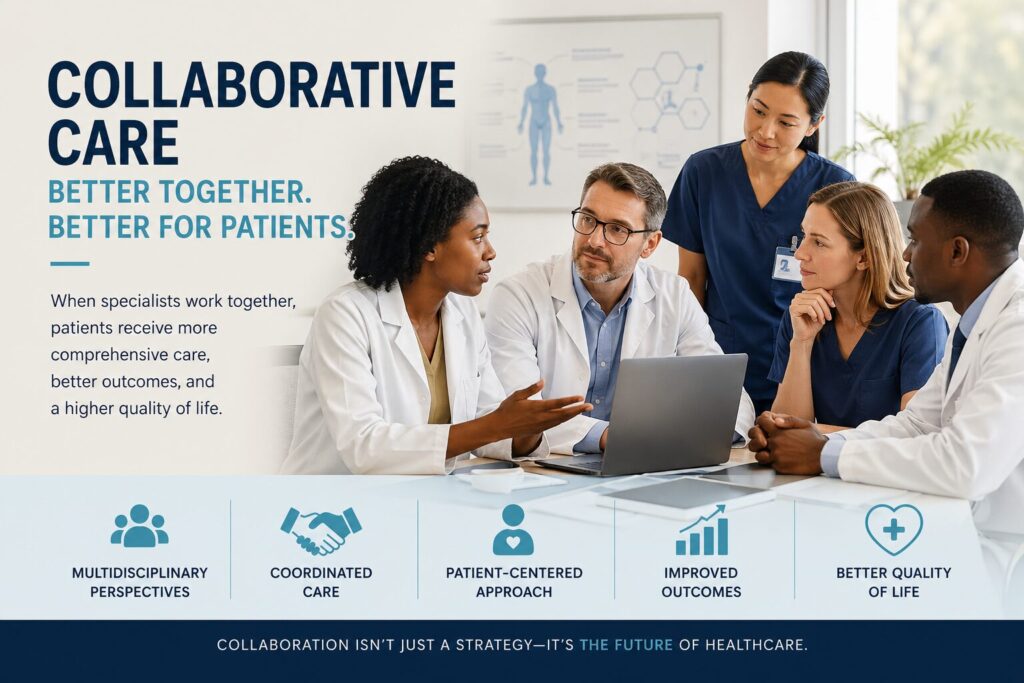
Healthcare is evolving—and so are the patients we serve.
Today’s patients don’t present with neatly packaged, single-diagnosis conditions. Instead, they arrive with complex, overlapping diseases shaped by immune dysfunction, systemic inflammation, hormonal shifts, and psychosocial factors.
In this reality, no single specialty has all the answers.
That’s where collaborative care comes in—not as a trend, but as a necessity.
The Shift from Silos to Systems
For decades, medicine operated in silos:
- Dermatology treated the skin
- Rheumatology treated joints
- Gastroenterology treated the gut
But science has caught up with what many clinicians already suspected:
These systems are deeply interconnected.
Inflammatory pathways don’t respect specialty boundaries. Conditions like psoriasis, psoriatic arthritis, inflammatory bowel disease, and hormone-driven skin conditions are linked through shared mechanisms.
Treating them in isolation leads to:
- Fragmented care
- Missed comorbidities
- Suboptimal outcomes
- Collaborative care changes that by asking a better question:
What if we treated the whole patient—together?
What Collaborative Care Looks Like in Practice
Collaborative care isn’t just about referrals—it’s about true integration.
It means:
- Dermatologists, rheumatologists, and gastroenterologists working together
- Advanced practice providers (NPs and PAs) playing a central role in care delivery and coordination
- Allergists, oncologists, and women’s health experts contributing to care plans
- Pharmacists actively supporting therapy optimization
- Shared decision-making across specialties
The result:
- More precise diagnoses
- More effective treatments
- Better patient outcomes
Why It Matters Now More Than Ever
1. Increasing Disease Complexity
Patients are living longer—with more chronic, overlapping conditions.
2. Rapid Therapeutic Innovation
New biologics and targeted therapies impact multiple systems.
3. Rising Patient Expectations
Patients expect coordinated, seamless care—not disconnected opinions.
4. Expanding Systemic Understanding
From the gut-skin axis to hormone-driven inflammation, medicine is more connected than ever.
Where Education Meets Action
Understanding collaborative care is one thing. Applying it in real-world practice is another.
That’s exactly where the Collaborative Care Summit comes in.
At this two-day event, you’ll:
- Engage in case-based, real-world discussions
- Learn from multidisciplinary faculty
- Explore emerging therapies
- Build practical frameworks for coordinated care
A Program Built Around Real Patient Needs
Sessions include:
- Inflammatory diseases and systemic therapies
- Psychodermatology and the mind-skin connection
- Hormonal health, including menopause
- Oncodermatology
- Lifestyle, nutrition, and integrative care
These aren’t isolated topics—they reflect the real complexity clinicians face every day.
The Power of Being in the Same Room
One of the most overlooked aspects of collaborative care is connection.
This summit is intentionally designed to foster:
- Meaningful conversations
- Cross-specialty perspectives
- Lasting professional relationships
Because collaboration doesn’t happen in theory—it happens through people.
The Bottom Line
Collaborative care isn’t the future of medicine.
It’s the present.
The providers who embrace it will deliver the highest level of patient care.
The question isn’t whether collaboration matters.
It’s whether we’re ready to practice medicine differently.
Be at the Forefront of Collaborative Care
If you’re ready to move beyond siloed thinking and into truly integrated care:
Collaborative Care Summit 2026
September 12–13, 2026
Hilton Orlando, FL
 https://diversityindermatology.com/collaborative-care-summit-2026